Wednesday, 19 March 2014

Comus

Comus were one of the most obscure and mysterious bands of the English prog folk scene of the '70s, with a formation of six elements and arrangements somewhat unusual for the time.The use of instruments such as violin, viola, oboe, with their substratum of folk and classical placed them very close to progressive rock,  although their sense of experimentation would be more akin to art rock.
The birth of the group started with an encounter between Roger Wootton and Glenn Goring in 1967, both seventeen, at Ravensbourne College of Art in Bromley, Kent. Both guitarists fans, they shared an intense passion for the work of John Renbourn and Bert Jansch (who soon would form Pentangle) and the Velvet Underground. The two began playing in various folk clubs, until they stumble into the Arts Lab in Beckenham, then followed by David Bowie, whom they supported on several occasions.

Acid rock series: Comus


Acid folk series: The mighty - Comus.

Review by   

Forty-two years. That's how long it has taken Comus to follow up their long legendary First Utterance debut, and you cannot even ask if the wait was worthwhile. A less than stellar second album, back in 1974, followed by a 35-year silence essentially rendered the hiatus redundant, and falling into Out of the Coma today is akin to rediscovering a priceless manuscript that should have been in our hands decades back. Yes, priceless. No matter that the album features just three new songs (all of them familiar from the band's current live show); no matter, either, that the rest of the disc is consumed by "Malgaard Suite," a rough live sketch of a song that would have made the next album, had the original band only stayed the course. This is Comus as we remember them and, more importantly, as we want to remember them: a folk noir nightmare that yelps, screams, fiddles, and tears at your ears with all the passion and originality that marked the first album to begin with. Less a follow-up, then, than a continuation; the three new songs scratch an itch that an album's worth of music inflamed all those years ago, while the 15-minute snatch of a hitherto forgotten suite bridges the years with a raw beauty, with its scratchy concert sound quality only adding to the sense of occasion. Of course, this is an album for the fans, not the neophytes, and yes, it is as much of a period piece as its predecessor. But that is what we wanted from Comus, and that is what they have delivered. Let the rite begin again!


Tuesday, 18 March 2014

Acid folk series: Mellow Candle.

Acid folk doesn't get any more atmospheric or beautiful than this, but the record buying public disagreed and after releasing just one album in 1972, the very fine SWADDLING SONGS, the group split up. These days, of course, it's considered as something of the holy grail of folk rock albums and you can't buy the album for love nor money. That's what a spiraling two way soaring vocal harmony is supposed to sound like, just in case you wondered.
Thanks to: Mind De-Coder. Tripped music for the discerning head.


Acid folk series: Nick Drake. New book by Nathan Wiseman-Trowse.

I have just purchased this book. Will give a review when completed.

Acid folk series: Nick Drake.


  • Nicholas Rodney "Nick" Drake was an English singer-songwriter and musician, known for his acoustic guitar-based songs. He failed to find a wide audience during his lifetime but his work has gradually achieved wider notice and recognition. Wikipedia


  • BornJune 19, 1948, Yangon, Myanmar

  • DiedNovember 25, 1974, Tanworth-in-Arden


  • Nick Drake (Nicholas Rodney Drake, Rangoon, Burma, June 19, 1948 - Tanworth-in-Arden, England, November 25, 1974) was an English  singer known for his gentle, enigmatic songs and his virtuoso right-hand finger picking technique. Although he recorded only three albums, critics and fellow musicians hold his work in very high esteem. Drake failed to find a wide audience during his lifetime, and had a strong aversion to performing. Since his death, however, Drake's music has gained a significant cult following. Read more about Nick Drake on Last.fm.

  • Saturday, 15 March 2014

    Skirr Cottage Journal: 6.

          Spring is definitely in the air. Last weekend saw my first sighting of a bumble bee and a butterfly. Best of all, the curlews are back on the moor above the cottage. First one appeared, settling in the field over our garden wall. The following day a small flock had arrived by starlight, their bubbling banshee-like calls bringing the rough pasture under the Edge suddenly alive and vibrant. Only one lapwing has been seen so far and I have yet to hear a local skylark, but hopefully it will not be too long before I hear their beautiful singing filling the sky.


    Friday, 14 March 2014

    Great acid folk series: The great underground folk band Heron.


     Heron is a British folk band founded in 1967, which released two albums and two singles on the Dawn label from 1970 to 1972. Both albums were recorded outside. The first - self-titled - album was recorded in a field by the river Thames; the second was a double album, which they recorded outside a Devon country cottage. (last fm)

    Wednesday, 12 March 2014

    Great acid folk series: Mark Fry. Dreaming with Alice.

    Fry was apparently unaware of the popularity of this album with collectors until sometime in the early 2000's. In the meantime he'd been busy building a solid reputation for himself as a successful artist. He returned to recording with Shooting The Moon in 2008, a more mature album of singer songwriter material, before revisiting his acid folk roots with an excellent collaboration with the A. Lords last year, I Lived In Trees.

    Tuesday, 11 March 2014

    Vashsti Bunyan and the vardo on South Uist.

    Jennifer Vashti Bunyan (born 1945 in Newcastle) is an English singer-songwriter. In 1970, Bunyan released her first album, Just Another Diamond Day. The album sold very few copies, and Bunyan, discouraged, abandoned her musical career and went travelling in a vardo taking two years to reach the outer Hebrides where she and her boy friend set up home in a croft. By 2000, her album had acquired a cult following; it was re-released and Bunyan recorded more songs, initiating the second phase of her musical career after a gap of thirty years.

    Great acid folk series: Vashti Bunyan.


    Great acid folk series: Vashsti Bunyan is the definitive goddess of underground folk!!

    Just Another Diamond Day!

    Thursday, 6 March 2014

    Great nature writers series: Kenneth Allsop.

    KENNETH ALLSOP (1920 – 1973) was born in Leeds and left school aged 17 to join the Slough Observer. He joined the RAF during the Second World War but left the service when injury caused his leg to be amputated. In 1949, he won the John Llewellyn Rhys Prize for Adventure Lit Their Star and later wrote the definitive account of 1950s British literature, The Angry Decade. He was also an accomplished journalist for Picture Post, Daily Mail and The Sunday Times. In 1955 he started reporting on television and in 1960 joined the BBC’s current affairs programme, Tonight, where he went on to become the nation’s best-known television presenter and commentator. He campaigned vigorously against oil exploration and woodland clear-felling in Dorset and Somerset, while his documentary Do You Dig Our National Parks? challenged open-pit mining in Snowdonia and became a milestone in Britain’s burgeoning environmental movement. - See more at: www.http://littletoller.co.uk/authors/kenneth-allsop/#sthash.yRs9IXSS.dpuf

    Great nature writers series: Henry Williamson.


    Great nature writers series: Henry Williamson's Writing Hut in Devon.


    Tarka the Otter's success in winning the Hawthornden Prize provided Henry Williamson with enough money (£100) to buy his own writing hut in 1928 at Ox's Cross in Devon, close to his family house at Georgeham. The hut - known as The Field - is now a museum and contains a selection of his personal effects, clothes and indeed his writing desk. The hut provides a major focus for the annual autumn meeting of the Henry Williamson Society as it did for Williamson himself who wrote his A Chronicle of Ancient Sunlight series of novels inside it.

    Great nature writers series: Kenneth Allsop.

    In the Country. Still a great book.

    Sunday, 2 March 2014

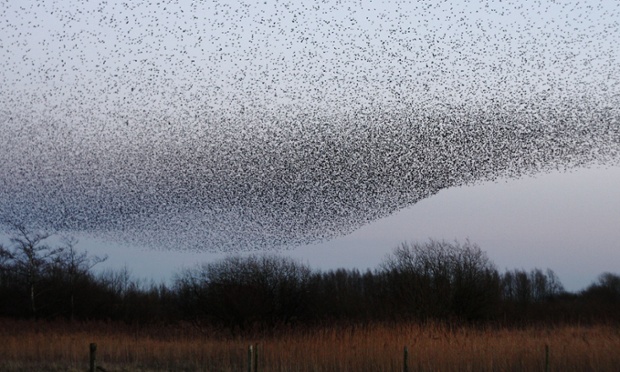
    A murmuration of starlings on Middleton Moor.

    Middleton Moor, Derbyshire on 19 January 2014. Photograph: Matthew Taylor/Rex Features.

    Skirr Cottage Journal 5.

          Just arrived back from viewing a murmuration of starlings on Middleton Moor, Derbyshire. It was cold, it became wet, but it was well worth it. A murmuration is always a spectacular sight, one of nature's great creative moments. The build up of small groups of twenty or thirty starlings flying in from various directions just adds to the anticipation of what is to come. At one point the ever-growing flock flew straight over our heads with a "whoosh!" As the flock grows larger and larger, possibly over sixty thousand birds, the kaleidoscopic shapes they form are amazing: I saw giant fish, dragons, mushroom clouds and writhing snakes. The birds cease to be individuals but morph into a 'solid' mass that heaves and flexes in all directions, then suddenly spirals down into the willows and reed beds to spend the night in relative safety from predators. This is a wonderful sight which is attracting many people which is not surprising.