Thursday, 17 April 2014

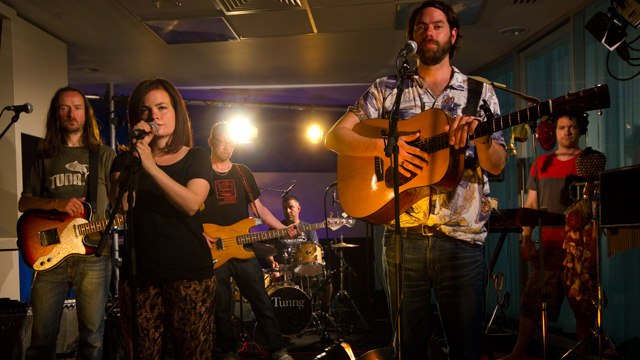
Acid Folk Series: Tunng.

Tunng are an English folk music band. They are often associated with the folktronica genre, due to the electronic influences evident in some of their work. Tunng are often noted for their use of strange instruments, including sea shells.
'Sci-fi-prog-folk-band' Tunng manifest themselves in the Guardian studio for an exclusive live version of their single So Far From here taken from their new album, Turbines. Turbines is their fifth studio album, released in June 2013, which sees them continuing to combine acoustic folk, electronic sounds and noises in unpredictable ways

Sunday, 13 April 2014

Acid Folk Series: Judy Dyble

Credits to: Artist Biography by 

Judy Dyble was the original female singer in Fairport Convention, singing with the group from around mid-1967 to mid-1968, and appearing on their first album and single. (She was actually not in the very first incarnations of Fairport Convention, which had no female singers, but joined only a few months after their first performance.) Dyble's reputation has suffered somewhat in light of her replacement by one of the finest folk-rock singers of all time, Sandy Denny, before Fairport's second album. In fact, though, she was a perfectly adequate and respectable vocalist, if somewhat chaste, particularly in comparison to Denny. With Fairport, she sang harmony and the occasional solo lead, as on the cuts "One Sure Thing" and "If I Had a Ribbon Bow," and also played autoharp.Fairport got Sandy Denny into the band to replace Dyble, partly out of dissatisfaction with Dyble's more genteel style, and partly to add a vocalist with a power that Dyble didn't possess. Dyble's career, though, didn't end there. She played a still-overlooked role in the genesis of King Crimson, who, despite their pompous prog rock image, actually had some folky roots. In June 1968, Dyble advertised in Melody Maker for a band, getting a response from Peter Giles, then playing with future King Crimson members Michael Giles and Robert Fripp in the trio Giles, Giles & Fripp. Ian McDonald, another early King Crimson member, was also working with Dyble. In 1968, some quite nice numbers were taped with a tentative band in which Giles, Giles & Fripp were fleshed out by McDonald and Dyble, bridging the gap between folk-rock and jazzy prog rock. A few of the tracks on which Dyble sang appear on the archival Giles, Giles & Fripp release The Brondesbury Tapes (1968), including two early versions of "I Talk to the Wind," which would be one of the songs on King Crimson's first album.Dyble didn't collaborate with the musicians for long, though, and soon she went her own way. Michael Giles, Robert Fripp, and Ian McDonald formed the nucleus of King Crimson, all three playing in the lineup featured on King Crimson's first album. Dyble did make another record, though, as part of the pleasant, if unremarkable, folk-rock duo Trader Horne, with ex-Them member Jackie McAuley. She sang, played autoharp, and piano, and wrote or co-wrote a couple of tracks on their sole album, 1970's Morning Way. Dyble left the recording scene after that, though she did appear in the 1990s at the Cropredy Festival, the annual folk festival that often features reunions of combinations of various Fairport Convention veterans.

Acid Folk Series: Judy Dyble

Album by Judy Dyble.
Trader Horne, with Judy Dyble. A must listen!!


Friday, 4 April 2014

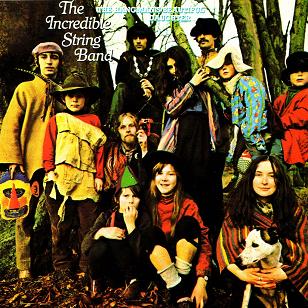
Acid Folk Series: Incredible String Band poster


Acid Folk Series: Incredible String Band

Could be the Middle-Ages if it wasn't for the girl in front centre wearing a watch!! A wonderful album!!!

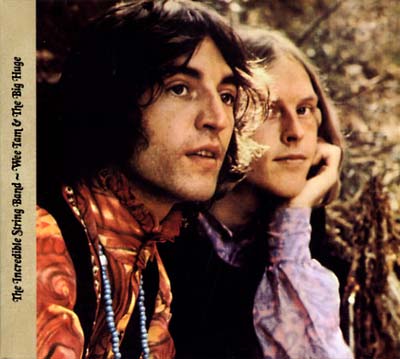
Acid Folk Series: The Incredible String Band.

The debut release from the original Incredible String Band trio -- Robin Williamson(violin/whistle/mandolin/guitar/vocals), Clive Palmer (banjo/guitar/vocals), and Mike Heron (guitar/vocals) -- was also their most simple. It is this minimalism that allowed the natural radiance of the band's (mostly) original material to be evident in the purist sense, and likewise without many of the somewhat intricate distractions and musical tangents that their future work would incorporate. Immediately striking is the group's remarkable and collective prowess on seemingly all things stringed -- hence, their apropos moniker. With an unmistakable blend of distinct instrumentation and harmony vocals, the Incredible String Band take inspiration from traditional music on both sides of the Atlantic. Their impish charm and tongue-in-cheek fairytale mythology also add to their folkie mystique. This first long-player -- originally issued in 1966 -- contains a bevy of songs that, while steeped in conventional folk music, are completely unique. This likewise holds true for the three traditional pieces, "Schaeffer's Jig," "Whistle Tune," and the rare Clive Palmer instrumental solo, "Niggertown." Palmer, formerly of the highly underrated Famous Jug Band, would exit the Incredible String Band after this record, and thus the perpetually rotating personnel that would guide the group for the remainder of its existence began, perhaps aptly, at the beginning. The original songs range from light and airy love ballads -- such as the Williamson solo "Womankind" or the understated mischief of "Dandelion Blues" -- to the high and lonesome sound of Mike Heron's mandolin-driven "How Happy I Am." There are likewise darker -- yet no less poignant -- tunes such as "Empty Pocket Blues" and the haunting "Good As Gone." While this album is a tremendous launch pad for potential enthusiasts, be aware that every Incredible String Band recording is also extremely individual and reflects the current membership of the group.

Review by   


The Hangman’s Beautiful Daughter stands as the Incredible String Band's undisputed classic among critics and musicians alike -- ask Robert Plant, who touted its influence on Led Zeppelin's first album and general direction. Recorded and released in 1968, the album hit number five on the U.K. album charts, and was nominated for a Grammy in the U.S. It was produced by Joe Boyd, and engineered by John Wood using 24-track technology. Robin WilliamsonMike Heron, and Licorice McKechnie also utilized the talents of Dolly Collins (vocals, flute, organ, and piano), and David Snell (harp). Williamson and Heron employed a vast array of instruments on these songs including sitar, gimbri, pan pipe, oud, chahanai, mandolin, guitars, Hammond B-3, dulcimer, harpsichord, pan pipes, oud, water harp, and harmonica. The songs were much more freeform and experimental. Check Heron’s 13-minute “A Very Cellular Song,” which incorporates elements from a Sikh hymn and a Bahamian spiritual. Using the Hammond, a gimbri, pan pipes, handclaps, and other instruments, it begins on a two-chord vamp that employs a vocal round in five-part harmony, with secular and spiritual lyrics. It’s simply infectious. Other notables include the stellar “The Minotaur’s Song,” with its call and response chorus played on guitars, upright piano, and six-part harmonies. It melds a children's song with a drinking song to humorous and utterly memorable effect. Elsewhere, “Waltz of the New Moon,” employs two-chord drones on acoustic guitar with a meld of Middle Eastern vocal styles and Scottish field songs. “Three Is a Green Crown” is a psychedelic folk song in all its hypnotic droning glory with Williamson’s primitive sitar playing featured prominently. The tender, exotic, "Nightfall,” the album’s closer, is a lullaby, with guitar and sitar accompanying the vocal in whole tone intervals. The Hangman’s Beautiful Daughter is the most ambitious, focused, and brilliantly executed record in ISB’s catalogue.
Review by   

Tuesday, 1 April 2014

Skirr Cottage Journal 7.

First local skylark heard near the allotment last Thursday inbetween the hail and rain showers. Also a sparrowhawk swept through the allotment in the area where the house sparrows and chaffinches tend to gather. On this occasion he left (for it was indeed a male) empty taloned. Buzzard and ravens also spotted above the copse on the hill. Butterflies and bees now making regular appearances on the allotment and in the cottage garden. Keeping an eye out for a brimstone butterfly, one of my favourites. Up to eight chiff-chaffs heard on Sunday at Rowsley, no willow warblers as yet. The curlews are displaying in the back field in good numbers. Romany (Bramwell Evens) would be happy! Looking forward to spotting my first local swallow or house Martin; they never cease to amaze me, having journeyed all the way from South Africa, what trials they must have encounted on route!