Submitted by mojoworking on 6 December 2012 - 4:37am

This piece originally appeared in a 1996 issue of Record Collector magazine as part of a much larger feature on Island Records. I was prompted to write it after seeing a short article in the debut issue of Mojo magazine which attempted to name everyone pictured on the Hipgnosis-designed cover of the famous 1969 Island sampler LPYou Can All Join In.
It was a brave effort by the fledgling mag which nevertheless fell at the first hurdle, with almost a third of the people wrongly named, or left unidentified. Stranger yet was that for their piece Mojo mag had consulted Patrick Campbell-Lyons of the Island band Nirvana who not only appeared on You Can All Join In but was pictured on the sleeve himself!
After that I became determined (if not obsessed) to come up with a definitive list of everyone on the sleeve. This was made all the more difficult because several people are only partially visible over on the left of the picture. Then I had a stroke of luck. During the project I’d amassed several copies of You Can All Join In and one of them, a Dutch pressing, showed about an extra half-inch or so of the picture on the left and this was all I needed to fill in the gaps. Suddenly here was Richard Thompson (then with Fairport Convention), Clive Bunker (Jethro Tull) and Chris Mercer (then with Wynder K. Frog) and the puzzle was magically complete.
A complete, accurate list had never been published before that 1996 issue of Record Collector and along with my hand-drawn line diagram of the characters as they appeared on the sleeve (see below), it was subsequently lifted wholesale by Wikipedia and now pops up all over the interweb.
I initially posted a short version of the list at the bottom of tiggerlion’s excellent Hendrix thread, but it’s kind of an orphan there, especially as the thread has gone into the twilight zone of a second page, where few ever venture. So here's the full-fat version for all you Island Records obsessives out there. Some of the references are a little twee and dated now ("Beazer Homes League", anyone?) so I hope you'll bear with me in that regard.
YOU CAN ALL JOIN IN
If you are of a certain age and took even a fleeting interest in what was quaintly termed ‘underground’ rock music as a teenager the chances are that you've owned at least one copy of You Can All Join In at some point during the past 40 years.
Along with Nice Enough To Eat and Liberty's splendid pair of Gutbucket compilations this was among the first of the many sampler albums which began to appear at the tail-end of the 60s. Offering stunning value for money at a mere 14s/6d (72½p) for twelve tracks (this at a time when a full-price LP retailed for around 32s/11d [£1.65]), not only did YCAJI and its ilk provide a low-cost opportunity to hear tried and tested music from Island's Premier League of bands (Tull, Traffic, Free etc), but they also enabled interested parties to check out some of the kick-and-run merchants down at the Beazer Homes League end of the scale (Tramline, Wynder K. Frog et al) at considerably less financial risk.
The Americans, in typical advertising agency speak, called samplers LPs of this kind 'loss leaders' and invariably flogged them mail-order for one dollar apiece via adverts on the inner sleeves of early 70s Warner Bros albums and the like. Britain, meanwhile, quietly sold them over the counter for considerably more than a dollar. The principle, however, was exactly the same: after being initially attracted to the sampler by one or more of the big names on offer, you'd be so impressed by some of the lesser-known bands that you'd immediately rush out and buy one of their albums, full-price. That was the theory, anyway.
Almost as important as the music in this case, of course, was that distinctive and much-discussed YCAJI sleeve. Many have tried but until now (this was written in 1996) no one has ever succeeded in correctly naming everyone pictured on the cover. One spectacular failure worthy of note was Patrick Campbell-Lyons' effort in the debut issue of Mojo magazine. Considering the Nirvana mainman was actually present at the time (he's the P.J. Proby lookalike at No.9), his attempt was woefully incorrect (9 wrong out of 27! A case of one Camberwell carrot too many on the day, perchance Pat?).
So, who exactly was present on that fateful winter's morning in 1969 when the cream of Island's roster gathered in Hyde Park? By referring to the accompanying diagram and key, everyone on the cover can be identified quickly, simply and - more importantly - accurately.
A word, however, regarding those musicians partially visible on the extreme left of the sleeve. Above Chris Mercer's head (No.23) can be seen a brown coat collar, together with a similarly-coloured clump of hair. These belong to a then considerably more hirsute Richard Thompson (No.13) - and not Paul Kossoff as is sometimes claimed. Now, go up still further and immediately above Thompson's head, directly to the left of Neil Hubbard (No.2), can be seen a small amount of darker hair of almost Brillo Pad-like texture. Sadly, this is all that is visible of original Jethro Tull tub thumper Clive Bunker (No.1).
There has, over the years, been much speculation as to who was positioned out of camera range further to the left. Various names have been mooted including: John Martyn (possible), Blodwyn Pig (unlikely), and King Crimson (extremely unlikely indeed, since they weren't even signed to Island at that point!). No, it's far more likely that these stragglers were the remaining members of Spooky Tooth, along with, possibly, various representatives from Tramline. Paul Kossoff meanwhile, as the only member of Free not accounted for, was probably safely tucked up in his Golborne Mews bed at that unsociable hour of the morning.
Then there's the sorry tale of nearly-man Ian A. Anderson (he's the bearded, bespectacled, fur-coated figure at No.16 who was dropped from the label, without a release to his name, shortly thereafter). If his Mojo account of how he lost his Island contract is to be believed, the erstwhile folk blues practitioner (now editor of fRoots magazine) was unceremoniously given the bum's rush due to an unfortunate clash of names with a certain similarly-monikered Jethro Tull frontman. Stranger things have happened, admittedly, but Ian A.'s version of events seems a little paranoid all the same.

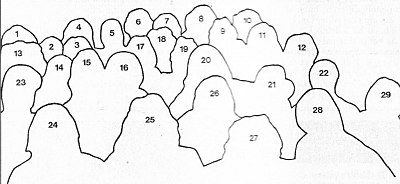 YOU CAN ALL JOIN IN - KEY TO DIAGRAM
1. CLIVE BUNKER (Jethro Tull)
2. NEIL HUBBARD (Wynder K. Frog)
3. GARY WRIGHT (Spooky Tooth)
4. GLENN CORNICK (Jethro Tull)
5. BRUCE ROWLAND (Wynder K. Frog)
6. MARTIN BARRE (Jethro Tull)
7. MICK WEAVER (Wynder K. Frog)
8. IAN ANDERSON (Jethro Tull)
9. PATRICK CAMPBELL-LYONS (Nirvana)
10. ASHLEY HUTCHINGS (Fairport Convention)
11. ALEX SPYROPOULOS (Nirvana)
12. CHRIS WOOD (Traffic)
13. RICHARD THOMPSON (Fairport Convention)
14. IAN MATTHEWS (Fairport Convention)
15. STEVE WINWOOD (Traffic)
16. IAN A. ANDERSON
17. JIM CAPALDI (Traffic)
18. MIKE HARRISON (Spooky Tooth)
19. MARTIN LAMBLE (Fairport Convention)
20. SIMON NICOL (Fairport Convention)
21. HARRY HUGHES (Clouds)
22. REBOP ANTHONY KWAKU BAAH (Wynder K. Frog)
23. CHRIS MERCER (Wynder K. Frog)
24. SIMON KIRKE (Free)
25. PAUL RODGERS (Free)
26. BILLY RITCHIE (Clouds)
27. ANDY FRASER (Free)
28. IAN ELLIS (Clouds)
29. SANDY DENNY (Fairport Convention)
2. NEIL HUBBARD (Wynder K. Frog)
3. GARY WRIGHT (Spooky Tooth)
4. GLENN CORNICK (Jethro Tull)
5. BRUCE ROWLAND (Wynder K. Frog)
6. MARTIN BARRE (Jethro Tull)
7. MICK WEAVER (Wynder K. Frog)
8. IAN ANDERSON (Jethro Tull)
9. PATRICK CAMPBELL-LYONS (Nirvana)
10. ASHLEY HUTCHINGS (Fairport Convention)
11. ALEX SPYROPOULOS (Nirvana)
12. CHRIS WOOD (Traffic)
13. RICHARD THOMPSON (Fairport Convention)
14. IAN MATTHEWS (Fairport Convention)
15. STEVE WINWOOD (Traffic)
16. IAN A. ANDERSON
17. JIM CAPALDI (Traffic)
18. MIKE HARRISON (Spooky Tooth)
19. MARTIN LAMBLE (Fairport Convention)
20. SIMON NICOL (Fairport Convention)
21. HARRY HUGHES (Clouds)
22. REBOP ANTHONY KWAKU BAAH (Wynder K. Frog)
23. CHRIS MERCER (Wynder K. Frog)
24. SIMON KIRKE (Free)
25. PAUL RODGERS (Free)
26. BILLY RITCHIE (Clouds)
27. ANDY FRASER (Free)
28. IAN ELLIS (Clouds)
29. SANDY DENNY (Fairport Convention)
Track Listing:
Side One
1. A Song For Jeffrey – Jethro Tull – (Alternative mix, original version from This Was) (ILPS 9085)
2. Sunshine Help Me – Spooky Tooth – (from It’s All About Spooky Tooth) (ILPS 9080)
3. I’m a Mover – Free – (from Tons of Sobs) (ILPS 9089)
4. What’s That Sound – Art – (from Supernatural Fairy Tales) (ILP 967)
5. Pearly Queen – Tramline – (from Moves of Vegetable Centuries) (ILPS 9095)
6. You Can All Join In – Traffic – (from Traffic) (ILPS 9081T)
1. A Song For Jeffrey – Jethro Tull – (Alternative mix, original version from This Was) (ILPS 9085)
2. Sunshine Help Me – Spooky Tooth – (from It’s All About Spooky Tooth) (ILPS 9080)
3. I’m a Mover – Free – (from Tons of Sobs) (ILPS 9089)
4. What’s That Sound – Art – (from Supernatural Fairy Tales) (ILP 967)
5. Pearly Queen – Tramline – (from Moves of Vegetable Centuries) (ILPS 9095)
6. You Can All Join In – Traffic – (from Traffic) (ILPS 9081T)
Side Two
1. Meet on the Ledge – Fairport Convention – (from What We Did on Our Holidays) (ILPS 9092)
2. Rainbow Chaser – Nirvana – (from All of Us) (ILPS 9087)
3. Dusty - John Martyn – (from The Tumbler) (ILPS 9091)
4. I’ll Go Girl – Clouds – (from Scrapbook) (ILPS 9100)
5. Somebody Help Me – Spencer Davis Group – (from The Best of the Spencer Davis Group) (ILPS 9070)
6. Gasoline Alley – Wynder K. Frog – (from Out of the Frying Pan) (ILPS 9082)
1. Meet on the Ledge – Fairport Convention – (from What We Did on Our Holidays) (ILPS 9092)
2. Rainbow Chaser – Nirvana – (from All of Us) (ILPS 9087)
3. Dusty - John Martyn – (from The Tumbler) (ILPS 9091)
4. I’ll Go Girl – Clouds – (from Scrapbook) (ILPS 9100)
5. Somebody Help Me – Spencer Davis Group – (from The Best of the Spencer Davis Group) (ILPS 9070)
6. Gasoline Alley – Wynder K. Frog – (from Out of the Frying Pan) (ILPS 9082)
Thank you to www.The Afterworld


.jpg)