Friday, 31 July 2015


Sunday, 26 July 2015
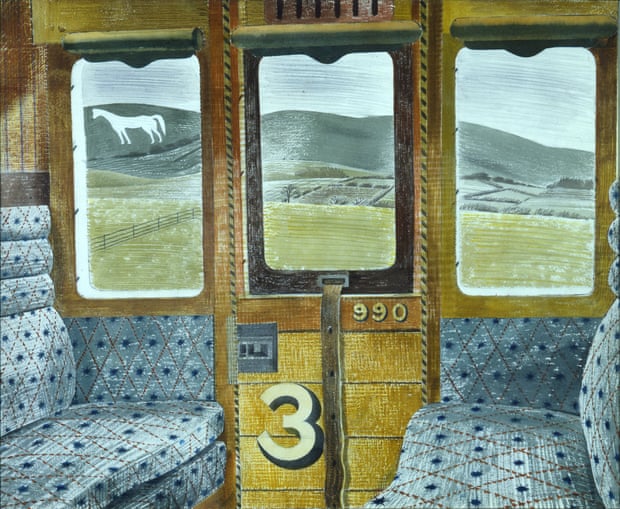
Great nature artists seies: Eric Ravilious.
English painter, wood-engraver and designer. He was educated at Eastbourne School of Art and then at the Royal College of Art (1922–5), where he was taught by Paul Nash and became close friends with Edward Bawden. His early works included the refectory mural (destr. 1940) in Morley College, London, and wood-engravings in the tradition of Bewick for the Golden Cockerel, Curwen and Nonesuch presses. In the 1930s he began painting larger compositions in a wider range of colour, and this led him to use lithography. Ravilious also produced designs for Wedgwood, including the celebration mug (1936) for the coronation of King Edward VIII, which was withdrawn and revised for the coronations of George VI and Elizabeth II; the Alphabet mug (1937); the Afternoon Tea (1937), Travel (1938) and Garden Implements (1939) china sets; and the Boat Race Day cup (1938). He also designed glass for Stuart Crystal (1934), furniture for Dunbar Hay (1936) and graphic work for advertisements for London Transport and others. Despite his success as a designer, Ravilious concentrated increasingly on watercolours. His landscapesand rural interiors often featured the downland and coast of southern England; haunting and lyrical, these works show a world in suspense and often feature chalk hill figures, and empty rooms (e.g. Farmhouse Bedroom, 1939; London, V&A). In 1939 he became a War Artist, and during World War II he depicted such subjects as De-iceing Aircraft (c. 1942; London, Imp. War Mus.). He died while observing a sea rescue mission.
Taken from the TATE website.
Taken from the TATE website.
Wednesday, 15 July 2015
Skirr Cottage Diary.
Having spent most
of the morning and early afternoon painting the inside of our small
conservatory, by late afternoon I felt ready for some outdoor space. I headed
for the old Cromford and High Peak railway track in Goyt Valley which is now an
interesting walk and cycle track leading to the now blocked up tunnel. The
track is only about a mile and half in length but links various footpaths, so a
circular walk is possible. The track is great for people who need to walk on
the flat or for wheel chair uses, enabling you enter right into the heart of
the moorland and enjoy some great nature and stunning views.
I was
hoping to see a short-eared owl but made do with sparrow hawk, several kestrels
busy hunting, two buzzards and some young wheatears using the walls as track
way.
But what
held my attention was taken up with the insect life on the verges; especially
the abundance of butterflies. Dark green fritillaries were in great numbers as
well as what I believe to be small heath butterflies. There were also
gatekeepers and six spot burnet moths and other insects beyond my meagre skills
to identify. As for the short-eared owl, well, there will be other days,
perhaps this weekend.
Tuesday, 14 July 2015
Skirr Cottage Diary.
A visit to North Norfolk proved to be a much needed tonic. As soon
as we entered the county it was like going back in time. A visit to Cley Marsh
produced three spoonbills and many black-tailed and bar-tailed godwits. The
marsh harriers were showing well and a white-rumped sandpiper proved a bonus.
Red kite and a passing osprey were also present. The numbers of little egrets
now, never cease to amaze me. Cetti’s warbler and bearded tits were good for
the year list also. Walking down the East Bank of the marsh I came to the
bankside where I first met Richard Richardson. That was many years ago but the
place hasn’t really changed that much once your out-and –about on the marsh.
A boat trip to Blakeney Point from Morston is
always great fun and good views of both sandwich terns and little terns are always
exciting; seeing them flying in with bills full of sand eels is great and the
seals are always a spectacular site. In the evening barn owls hunted in the
meadows near Stiffkey (once the home of Henry Williamson) and little owls were
heard calling.
Titchwell
Reserve rarely disappoints, even though summer is perhaps not the best time.
But some waders were beginning to arrive including spotted redshank, ruff,
dunlin godwits and green sandpiper. A Mediterranean gull was found among the
many black-headed gulls and two little gulls.
Everywhere
wild flowers were in full bloom, especially the poppies and a walk along the
cliffs to Sherringham through the meadows of the nature reserve was like
walking through a vast wild flower garden. North Norfolk
will always be a magic place to me.
Sunday, 12 July 2015
Stars of Morning.
Sleep seems
a sensation of the past.
The night
hours have become half dreams,
Some kind
of between world trapped in crazy shadows.
Reality
becomes blurred, a shadow on dark water
Voices
whispering from some distant place.
Stars give
way to morning and the first blackbird stirs.
The tawny owl
returns to roost;
I sense the
first splutter of emerging dawn,
The cold
light folding in from the fields,
Spectres
dancing the dew path.
The blackbird
begins its song, then another, and another;
I hear a
wren scold the dawn, a song thrush,
Then a distant
curlew below the Edge,
Bubbling
like spring water.
The light
is stronger now, daylight comes creeping
And the
world is suddenly on view.
The stars
have melted to infinity
As if they
never were;
They too
have gone to roost
To return in
the blue quiet of memory.
Flint.
I stoop to pick up a piece of polished flint
A piece of sedimentary cryptocrystalline, a form of the mineral quartz
A piece of sedimentary cryptocrystalline, a form of the mineral quartz
Smudge red and orange,
A galaxy reflected on its surface.
Why this fragment among billions I do not know;
It seemed to choose me rather than me it,
Calling through a million years of upheaval and change.
It fitted into my palm snugly as if a missing part of me,
A homecoming spanning epochs.
So smooth to the touch like silk, yet harder than iron
It pinned me to the spot, rooted me to earth
As if I had sprouted roots like a mighty oak tree;
I heard the stone song reverberate through the heavens
Bringing life into existence,
The song of making weaving through ancient tunnels
Stirring the darkness to life like a flame in the
wilderness.
I knew then
we couldn’t be parted –
At least for
a short time.
Hol weg
It was good to find the secret silence in the earth,
To be among roots, gnarled and worn only
By the wild creatures of the holloway.
Inside the whale-ribbed forest
There was a strange bee drone, an earth hum.
Footfall and the plodding hoof
And the rambling carts have dug deep
As the soft
rock as yielded.
Rivers of
rain have converged
To snake
through the soft soil and stones,
Deeper and
deeper into the martyrs lair;
Soon the lane
is sunken into fleeting shadow
Weaving
through the roots of time.
Then the
trees, slender ash, holly, beech
And elm,
reach over to join and lace together
As if in
prayer, as if to conceal the secret maze
Even from
moon and star.
Soon the road
becomes lost in the landscape,
Lost to
memory like a fading picture.
Yet memories
still linger as shades,
Fixed in the
very fabric of the place,
Recording
your pilgrimage, your journey
Through the
dimness of the old way.
Subscribe to:
Comments (Atom)